Thursday, June 13, 2019


Sunday, May 5, 2019
Write about:
Write about sunshine and mesquite trees heavy with pollen blooms.
Write about plants rooting in new soil.
Write about stars in the western sky popping out of the dusk darkness.
Write about baseball, its rhythms and ballet moves on the mound and infield.
Write about the crack of a bat from the powerful left hander.
Write about kids snacking on ice cream with dad wiping their faces with his t-shirt sleeve.
Write about stories--the bedtime mystery, the afternoon on the patio Irish tales of women gone wrong.
Write about stories--dragons in the sky, Indiana Jones taking a step across the chasm.
Write about stories--fairy tales and Nancy Drew, Bobbsey Twins, and Bible passages.
Write about what is elusive: joy, bliss, peace of mind, quietude--
until I write about all of it.
Sunday, April 21, 2019
Sights and Sounds from the Passover-Easter Weekend 4.21.19
Shabbot candle and prayers in Hebrew and English. We kept the door open at sundown to welcome anyone to join us. It remained just the two of us, but past and present family and friends were with us at the table
A simple meal of roasted chicken with olive oil, salt and pepper and rosemary cut from our yard. Matzo and meringue cookies. We finished the day with a ride through yellow blossoming palo verde trees and the breeze of sunset. Coming down the foothills, the pink full moon waved us home.
Saturday was stuffed with "to dos" that got done so we could relax on Sunday. An early task was planting a few marigolds that reminded me of my mom and her mom. In the middle of the day, we enjoyed a stuffed egg salad sandwich at Rin Con Market. At night, we watched the first hour of Cecil DeMille's the Ten Commandments during light Passover meal of matzo, greek salad, and grapes. I first saw the movie at the Crocker Theater in Elgin, Illinois and watched in amazement as technicolor parted the Red (Reed) Sea into a new world for Jews and Gentiles. On the other side of the sea, the Commandments, behind the Jews as they crossed, soldiers and the plagues, in front, far way, the prophesy of the Messiah.
Later, I listened to Mozart.
In the morning of Easter, the breeze turned to wind. I watered flowers, fed the birds. Skimmed the news and dressed for service. The big Methodist music at Catalina Methodist Church, exceeded expectations. The words from the music and from the pulpit of Pastors Dottie and Jamie brought an interfaith and "all are welcome here" message of mindfulness in the "meetup" moments we take with us into the broader and sadder world.
At the end, brass, organ and full choir four voices (the sopranos soared) welcomed us to stand and sing Handel's Messiah chorus.
I lost count of how many "alleluias" we said or sang this morning.
As the day ends with another simple Passover meal, punctuated by a return to secular life, I will watch Judy Garland and Fred Astaire in "The Easter Parade."
A full weekend of reflection, meaningful memories old and new, and faith and hope triumphant over fear.
 De Grazia Chapel, now perished by fire
Sunday, April 7, 2019
Roller Coaster Ride and Tripping Over Tile
It's been a heck of a week and, as I write this, I am ready to turn in and tune out. But I promised myself (and whoever follows me on FB), that I would add a post to my blog soon. So here it is.
My roller coaster ride has not been fun and I have not yet been to the County Fair. Rather, for a few weeks, I have been up and down inside and out. And we have been having our two bathrooms updated, including switching out a fall-prone deep tub for a walk in shower in our master bath.
My primary doctor actually coined the "roller coaster" phrase for me last week and it fits. Right now I am on a plateau and hope that's where I will stay for awhile. I don't care for sharing all the grisly details so I won't and, heck, who wants to read that anyway. But here is a funny (after the fact) story that has come out of it that I will call "Tripping Over Tile."
So, on Tuesday, the tile crew (great guys from Arizona Restoration Experts), left a box of the 1 inch floor tile on the floor by the new shower. It's important to note that we had Italian tile installed--super heavy and durable. My husband was preoccupied all evening with the floor and drain. He had asked (and they complied) to have the drain and part of the floor redone after the first layout had too much of a slope to suit him. He's a safety professional and tough project manager which is important to the story.
So he's looked at the floor and drain multiple times. We go to bed. I am exhausted from two days of stomach pain, the doctor's visit and referral to GI specialist. (The ending of that episode is pending, but with samples of a medication, I am feeling better). About 1 a.m., I wake up to go to the bathroom. To get to it, I have to walk past the shower and then turn into the toilet room which has a separate door. The door is often closed. But, on this night, it is open. Another important detail.
Half asleep, I am walking. Yes. And I trip over the tile box. I am heading headlong forward, on my way to hit our concrete floors when I instinctively grab the toilet room door handle Good news: it stops me from falling. Bad news: the force of my falling pulls the handle toward me and into my cheekbone. The four letter word that starts with an F cascades out of my mouth and I scream in pain and regret, calling out to my husband, "the safety professional". One hour later, I am nursing my face and around my eye--which barely avoided the impact of the door knob. Next morning, a bruise (but little swelling) appeared and it's been that kind of a week.
I share this with the post script that, the next day, we went out and bought auto night lights for both bathrooms. We have lived in this house since 1997 and it's the first time we added night lights. So, we have the "safer" walk in shower (which we love), the tile box has been removed, and we have more light in the dark.
Here's a question for readers: when have you ever "tripped on the tiles"? Did you adjust to the darkness or add more light? In the spirit of the coming Passover and Easter Season, let's agree to not accept living in the dimmer light and take whatever "steps" we need to take to avoid disasters that are right in front of us...even if they are on the floor.

Thursday, March 21, 2019
More than Obituaries
More than Obituaries from A Local Paper
 |
| Ted de Grazia fresco formerly seen in The Chapel |
Everyday I skim most of the newspaper except for the comics
and the obituaries. With the comics, I
look for a laugh or a bit of wry wisdom tucked into the images or
dialogues. With the obituaries, I look
for the faces of those who have recently died—or sometimes an obituary repost
as memoriam. I know that photos are
costly, especially when they are in color.
For my parents, I wrote a simple text with no photo. They wouldn’t have wanted the expense, so I
honored their practicality. But both my
in-laws had photos and long texts which mirrored the dramatic ways they lived
their lives compared to my parents’ common-sense frugality.
So maybe I look at the pictures wistfully, wondering who
wrote the text and selected the photo that sums up an entire life. Did siblings argue and deliberate over every
word and selection as in my husband’s family?
Or did a friend or one child step up to the task just to get it done, as
in my family. My sister didn’t sit by
either of my parent’s deathbed, didn’t deal with the paperwork and arrangements
and didn’t attend my mom’s stone placement or my dad’s nearby military funeral. But, as the eldest, I had the job of doing it
all. When it was done, I was thankful it
was simple and didn’t have the complexities of too many cooks in the kitchen,
or too many children trying to direct their parents’ denouement.
Thus, I selected these two following obituaries because of a)
photos that were posted by their names and b) the terseness of their
stories. I wanted more for them (and
maybe from them), so I took bits of truth from their actual obituaries and wove
in my imagined mystery of their lives.
***
I.
Gaye
Jordan Dixon
Gaye
gazed at her face in the mirror before pinning the cream-colored hat on her
auburn hair. “My nose”, she considered
for the millionth time, is a bit too round for anyone—except Bill—to call me
pretty. But my nose’s length fits my
face and balances the curve of my definitive eyebrows. I
like my smile. I just need to remember
to smile more, especially today.” Gaye dotted both lips with her newly purchased
Helene Curtis cinnamon-red lipstick. The
silver earrings, something borrowed from her Aunt Meg, poked out beneath her
curls and the new hat. “There”, she thought, “Aunt Meg’s earrings are the final
touch, making me the glowing bride of Hershaw, Virginia. “
Gaye
gaily (yes, today the word today fit her like her hat) swirled around her
apartment, before leaving to meet Bill. She
was no traditional bride; the war had broken many traditional behaviors which
Aunt Meg reminded her often. “Well,
Auntie, times have changed and I am changing, too” was Gaye’s frequent
response. Her job as manager for the Navy’s
on base grocery store was a big leap after high school and working at the A&P.
As she walked up the concrete steps to City Hall, her navy jacket with silver
buttons informed strangers whom she passed that here was a woman who walked to the
tune of her own bugle.
Bill was
already in the lobby, waiting for her entrance.
Gaye knew the quickened click, click of her leather pumps against the
marble floor mirrored the accelerated pace of her heart. Oh, how she loved him and he was so handsome
today. He didn’t often wear his full
Navy uniform when off duty, but today was an exception. They were finally formalizing their “matched
pair” status. They were both children of the depression and brought up with the
Methodist values of hard work and duty.
They weren’t youngsters and were frugal with their salaries. And she knew that Bill had been fidgeting
about this day for over a year. He was
tired of trying to keep their shared nights a secret from both families and
Gaye agreed that pretending they weren’t already sleeping most nights together was
getting complicated. Particularly, Aunt
Meg had a sixth sense about Gaye’s social life and Bill’s Navy Pharmacy
Supervisor didn’t approve of any fooling around of his staff. “He runs a tight
ship on land and sea and thinks all of his staff should toe the line just as he
does,” Bill often complained. But, once
they were married, they could let go of pretenses and Bill would move into Gaye’s
two-bedroom apartment.
As she
walked down the hall, sunlight piercing the tiled floor, Gaye pictured the
years ahead of them, once the war was over.
Maybe a couple of kids. Raise
them in the mountains out west, open a lumber mill like his dad had done in
Virginia. Sure, there would be
challenges, but they’d face them together.
After the war, no challenge could beat them.
Even, she
thought, in our later years, with the kids grown, she figured they’d find ways
to be unretired and stay busy, happy. With
Bill’s strong constitution, matched by Gaye’s intelligence and will power, they
would stroll into the western sunset with smiles on their faces, arms entwined.
***
In the local
paper announcing Gaye’s death, I saw the photo of the two of them, probably on
their wedding day. Gaye died about six
months after Bill, so her time alone in the sunset was blessedly brief.
II.
Ginny
Dobbs
Ginny and Tom had a dream and, after
the depression was over, ran a motel in Tucson called Dream House. They brought
it cheap and it had seen better days in the 1920s when Tucson had its first
burst of growth when the train tracks were opened. Back
in the 1940s, their Dream House pulled in a steady stream of day trippers along
Miracle Mile. A few babies were born on
the bed sheets Ginny washed and a few lovers hid behind the window curtains she
sewed and pressed.
When the freeway was built in the
early 1960s, the motel income faded along with the bed sheets and curtains, so
Ginny and Tom turned to other enterprises and ran them smart. Tucson was a growing town and working folks
had cars that needed frequent repairs. When repairs couldn’t keep cars running, the
cars needed to end up somewhere, so Ginny and Tom opened a wrecking yard
stocked with broken vehicles, odd pieces of concrete, and multi-colored spooled
wire.
Gifted with a mind for figures and
facts as well as a bouncy smile and sparkling eyes, Ginny could warm the hearts
of disgruntled customers. To sweeten the
mood often experienced at a wrecking yard, she sold freshly baked goods on the
side. Irish soda bread was one of her specialties. After Tom died, Ginny kept occupied with
cooking, sewing, and tending their grandchildren. Never one to be idle, when her kids took over
the family business, she became an admissions clerk at St. Mary’s Hospital. Ginny lived a life of ninety-four years.
***
As I looked at her newspaper photo,
taken some time in her mid-life, she is wearing a dark dress and smiling
broadly at the camera. I consider that Ginny
was probably not a remarkable woman in the larger sphere of life, but her face
in the obituary column photo pulled me toward the details of the pearls in her
ears and pearl strand around her neck.
Maybe Tom had given her that jewelry set for an anniversary gift. Such a gift would have been precious to her
for decades.
I can envision the scene after
Ginny’s last heaving breath in hospice care--with a resigned shrug, her
daughter puts the treasured pearls in a green velvet jewelry box. She covers the box with one of Ginny’s
pressed handkerchiefs and shuts the drawer.
The hospice nurse closes Ginny’s eyes and wraps a blanket up to her
chin. Ginny is no
longer able to see the blooming yellow mesquite tree outside her window.
Thursday, February 14, 2019
From a photograph at Mariann and Jim's house
In my last blog, I wrote about our lovely memories of times at Mariann and Jim Laue's home. I also shared the recipe for her casserole.
Today, I am looking at a photograph Mariann sent me several months ago. Taken around 1988-89, it shows me, my son and the Laue's dog, Spicer, standing in front of their Virginia home. Aron is around six-seven years old and I am not quite or just forty-years old. It's before Instagram or cell phone photos and the photograph paper still has a shiny sheen .
There is a porch light on by the front door so I am guessing it is after dinner--or maybe Mariann's casserole is still bubbling in the oven. I am wearing a white sweater draped over white pants and blue t-shirt. Aron is in black basketball shorts (he was already mastering those skills thanks to being a part of the Tucson fan base for UA Wildcats), white t-shirt with a colorful "love the Earth" design and green/pink fanny-pack hanging from his waist. Spicer is in his last years, full-bodied and panting after what was probably a short walk.
My right hand is on my son's shoulder and left is holding the dog's leash. Aron is looking at Spicer, left arm outstretched to pat the dog.
There is nothing particularly special in this moment, except there we are. A young mother and son enjoying hospitality from friends, relaxed and happy in Virginia.

Sunday, February 3, 2019
Mariann's Casserole
Mariann's Casserole (response to Poets & Writers Week #52 Creative Non-Fiction Prompt).

I came to know Mariann Laue and her late husband, Jim, through my 1980's work with the Kettering Foundation. One of their staff members introduced me to Jim and his social justice work. Jim Laue was appointed by the U.S. Justice Dept. to join MLK's Civil Rights events. He was with Rev. King when he was shot. In the historic photo of the shooting on a hotel patio, it is Jim's handkerchief that is covering Martin Luther King's face. Jim Laue worked with the Kettering Foundation as he transitioned from social justice research to the specific field of peace and conflict studies.
Jim's academic role was at George Mason University where he established their Peace Studies Program. As a consultant with Kettering's National Issues Forum research on peace, I was sent to Washington D.C. periodically. One time, I extended my working visit a few days after being invited by Jim to stay as his residence in Virginia. I felt as if I had a found a second family with him, his wife, Mariann, and their still-at-home son, Ron. For the following three or so years, their home became my second home and a couple of times I brought my husband and our young son with me to stay with Jim, Mariann, and Ron.
Enjoying Mariann's "Methodist" casserole on a late summer evening was one of our quiet treats. She often set the stage for dinner by playing a few hymns and pop tunes on the piano. Our son would pet their German Shepherd, Spicer, or throw tennis balls to this gentle four-legged giant tennis as they played on the Laue's rolling backyard lawn. The casserole, served on the Laue's screened-in porch, would be accompanied by Pepperidge Farm French Bread, fresh from the oven.
Dessert was light---such as sugar free peach ice cream because Jim was an insulin dependent diabetic. I add this detail because Jim usually had to give himself an insulin shot before we were served dessert. The disease took him too soon. Mariann, who is a two time breast cancer survivor, eventually remarried. We stay in touch during Christmas and she and her blended family are growing with their children's spouses and children. I hope Mariann continues to serve her casserole when the grandchildren come to visit and plays her songs on her piano as the bread and casserole bake.
Even though our son grew up to be a professional chef, this simple recipe is still one of his "comfort food favorites."
Brown a pound of ground beef (can substitute ground turkey) with 1 tsp of ground oregano in oil.
Boil two cups of egg noodles.
In an oven-proof bowl, mix the cooked noodles and browned ground meat with 1/3 cup of water and 1 can of tomato soup.
Top the mixture with 1 cup of shredded cheddar cheese.
Bake uncovered in the oven at 350 degrees until cheese is thoroughly melted and mixture bubbles. (10-15 mins.)
Serve with warm bread.
Sunday, January 27, 2019
Domestic Apologies
(Note: format is attributed to "The Domestic Apologies" by Dustin Parsons found in 1/27/19 Sunday Shorts, Creative Nonfiction.org)
Apology to my indoor succulent plant
You have roots curling in brown water and need to be potted. But I enjoy the way western sunlight shines on your petals and even the brown water glistens.
Apology to my cat
I have to step over you or around you and often I trip on the red rug I crocheted for you. I am clumsy sometimes and need to practice my balance.
Apology to my office
You serve a purpose and yet I often ignore you because the computer beckons me to write and do bills.
Apology to my rocking chair
You comforted me in my teen years and I took you to my college dorm. I brought you to Arizona and you warmed me as I rocked my young son into sleep. Yet now, I use you to hold my scarves and haven't sat on your cushion in years.
 |
| Renoir |
Sunday, January 20, 2019
My memory of bedtime stories
(response to Poets & Writers Prompt "The Time is Now" 1/20/19)
My memory of bedtime stories begins with my Grandmother Dice (my mom's mom), reciting "Little Orphant Annie" and "The Raggedy Man" (by James Whitcomb Riley). My sister, cousin and I cuddled under woolen blankets in the attic bedroom at my grandparents' farmhouse on Randall Road in Elgin, Illinois. I didn't learn until years later than my grandmother and my mom grew up entertaining other farming families by poetry and dramatic reading recitations. One of mom's childhood favorites (also by JWR) was "Our Hired Girl".
Grandmother would perform her stories on the side of the bed and end with "Had a little calf; that's half. Put him in a stall; that's all." Those lines meant: no more stories, no more trips downstairs to go the to the bathroom; it's time for bed. And she meant it. A couple of time I tried tiptoeing down the creaking stairs and she'd be waiting for me at the bottom. "March right back up young lady!" was her command. Sometimes a hard swat would follow if I tried to resist.
Mom's nighttime routine included hand gestures, voice inflections, and tolerance for "just one more." She never seemed to tire of sharing her performances. Later, when my sister and I became early readers, we had the "Big Big Story Book" and illustrated fairy tales. Sitting on each side of her on one of our twin beds, my sister and I would lean in and look at the pictures as she read in her mesmerizing dramatic voice. I loved "The Wild Swans" and "Beauty and the Beast" because both stories were long and mom never stopped a story before the ending.
Mom continued this tradition with her grandson and two granddaughters--but not as often as she would have liked. She made sure I understood that moving from Illinois to Arizona meant she expected more grandchildren sleepovers than what she experienced. I think our son (being the first born) benefited most from her talents and she expanded her performances with him to include silly songs such as "On Top of Spaghetti" (sung to the song "On Top of Old Smokey") and "How much is that Doggie in the Window?".
I started reading to her grandson when he was a month or so old. The family tradition continued (I only needed a quick "read me a story" anytime of the day) until he was 12 years old. I read all of the C.S. Lewis books twice and several books by Brian Jacques--along with Pooh stories and fairy tales, of course.
In my late 50's, I began to volunteer read at elementary schools and the public library. The last story I read aloud to 5th graders was "The Little Prince" which had been published as a pop-up book. We learned about astronomy, love, adventure, and death from that amazing story.
Entering my 7th decade now, I occasionally still read children's stories to myself. I hear the harmonic voices of my mom and my grandmother in my head. Sometimes I see my mom's gestures in the moonlight. These memories create a sweet bedtime song I hope to sing for many more nights.
Saturday, November 3, 2018
The Blue Scarf draft preview

The Blue Scarf
Nora Bergatti wore the teal blue and gold scarf around her shoulders. An early autumn wind off Lake Michigan picked up the silk fabric, stroking her cheek as Mama used to do. Seeing her husband, Hugh, depart for the airport that morning, Nora knew that being alone for a week was an opportunity to explore the unpacked art files in her office. She removed the scarf from her shoulders and rolled it into a ball, tucking it into her satchel. As she walked up the steps to the museum, she patted one of the two marble lions on his head--a gesture of habit since she and Mama visited the exhibits every month in thirty-five of Nora’s forty years. Even with Mama gone, the habitual gesture recalled those visits.
But Nora was unaware that when Hugh returned, she would not be the same woman. The blue scarf in the satchel knew this. Since 1885, it carried all its memories between its threads of blue and gold--
My story is an old one, but not as old as the scarves made before me. Each of them as a story, too. But this is mine. My makers weren’t weavers. They were textile workers who came from farms in disarray. The centuries old feudal system in Italy, as in most of Europe, was gone. Peasant farmers were free, but as poor as ever. They had land, but no tools to work the land. Their former masters now could enslave them in debts for tools, for housing, for food. So many of them left the hills, such as my textile workers. They came from the Abruzzo region and entered Roma, looking for jobs in the newly built factories that were close to water and land transportation. The trains came in the late 1880s so workers could live in the cities, work, earn some money, and return back to the farms to work their land.
These workers didn’t bend and weave the silk threads. The threads continued to come to Europe over the Silk Road from Asia. The workers learned how to operate the silk through the steam-powered Jacquard mechanisms. These machines cut textile labor by half and so costs could be reduced. There was a new middle class emerging that wanted the finer goods that only the rich used to be able to purchase. The new machines changed everything and transportation also became less hazardous and more efficient.
A new style of design for patterns came from France, called Art Nouveau. In Italy, it was called Arte Nouva or Stile Foral. The designs were made in sinuous lines, whiplash curves, flowing lines, expressing a new freedom and release from traditional textile designs. This design style affected the visual imagination of women who felt the flowing lines in their hands. The sense of energy for a new life for women slowly came into the daily life of those who could afford the fabrics.
Such is the story of my first owner, a woman named Maria Fontevilla who lived in Fiesole. Fiesole was an ancient Etruscan village, but Maria was from Roma. She had married Raphael ten years before the blue scarf entered her life. Then, Raphael had completed his legal studies. Now, he was the Mayor of Fiesole and he bought me from a shop in Rome while finishing a legal case in the city. It was the eve of his tenth anniversary to Maria. Lately, she had been more subdued than usual. In these ten years, the third baby was a fussy one and the other two boys were at an active age. So sleep for his wife was a rare visitor. Raphael saw the silk scarf and thought, with its golden threads woven like a river around its edges, Maria would be reminded of Roma and happier times in their marriage.
So I was wrapped in parchment paper, rolled into a bundle that could fit in the carriage behind Raphael’s work papers and we went up the steep hill to Fiesole. My long life as an accessory to three women and one man’s stories had begun. Like her great-niece Nora, Maria was unaware how my presence would change her forever.
“Here you are, my lovely. You might have thought I forgot our anniversary, but I did not.” Raphael offered the paper bundle to the woman sitting at the table who held a baby nursing at her breast. The baby sniffled and Maria pushed it away and wiped its milky lips with a cloth. She looked up at Raphael with a slight smile.
“Well, you are forgiven then. For forgetting to say as much to me before you left. So busy you were with your life in the city.” Maria sighed and placed the baby in a cradle next to the table. “Now you are fed, Claudia, please be content for a few moments.”
She took the rolled bundle from her husband and untied the raffia string, slowly unwinding the parchment paper. A hint of blue like the ocean appeared.
“What is this, Raphael?” Maria's smile widened.
“Something new I saw today. I liked the colors as they shone in the window.”
“Oh, my." Maria unwrapped the scarf and the glints of gold caught in the setting sun, the blue fabric rippling like liquid in her hands.
“It is so beautiful. So fine. Too fine for a weary mother like me.”
“No. It is perfect for you, For a new mayor’s wife. You will wear it to the next town meeting to show everyone you are a lady of this village.” Raphael picked up the scarf and looped it gently around his wife’s long neck like a bracelet. It fell across her full breasts and his eyes lingered.
Maria touched the silk and a current of energy from it flowed into her fingers. Then the energy flowed into her quickening heart. Her eyes opened up to see the sun in the window and, for the first time in months, her legs felt strong again. “I am a lady of this village. I am more than a milk cow, cook, cleaner, and nurse to little boys’ colds and knee scrapes,” she murmured.
Yes, I whispered into her blood as it flowed throughout her body. I was made of silk from China, tended in a silkworm farm by a Chinese farm girl. She blessed the silk with her pure heart and mind and now her soul is mixed with yours. My magic has begun.
Friday, October 26, 2018
Exploring the Gardens
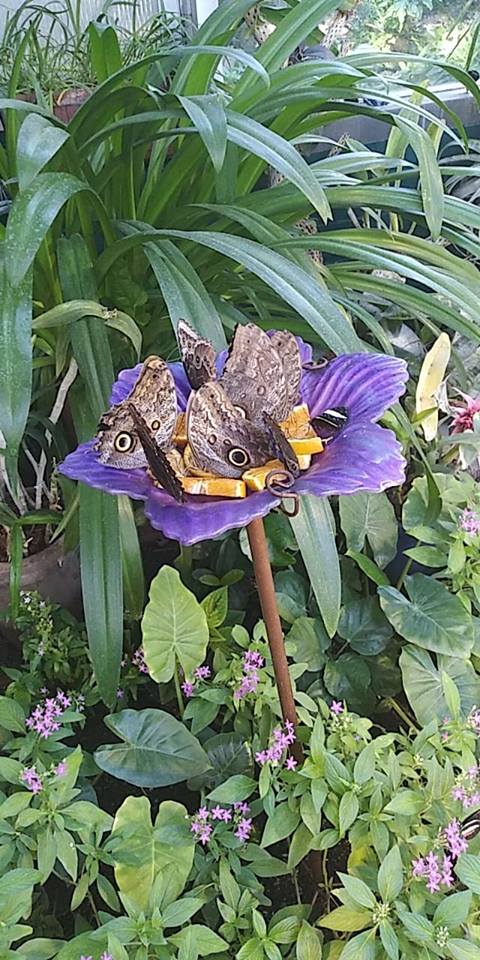
Today my friend and I strolled through the Tucson Botanical Gardens and we had it almost to ourselves. One chicken, multiple birds and butterflies accompanied us and a few lizards skirted across our path. Enjoy these few photos. I went a little crazy on my facebook page, too. www.facebook.com/anitafonte




Sunday, October 7, 2018
The Blue Scarf
She wore the blue scarf around her shoulders. A light wind picked up its edges, caressing her as Reginald used to do.
Seeing him off at the metro station, she knew that being alone for a week was an opportunity to dare herself to do something differently.
She tied the scarf in a knot around her throat, hiding the scar.
When he returned, she would not be the same woman.

Seeing him off at the metro station, she knew that being alone for a week was an opportunity to dare herself to do something differently.
She tied the scarf in a knot around her throat, hiding the scar.
When he returned, she would not be the same woman.

Sunday, September 2, 2018
Bits and Pieces of Children's Writing
Bits and Pieces from the prompts in Children’s Writer’s Notebook
A.A. Milne
Inventing characters from your childhood and write a 300 word adventure
Brownie: stuffed collie dog; Teddy: teddy bear; Oma: sock like toy; Mortimer: Mickey Mouse toy; Lulu: finger puppet
Location: Reid Park, Tucson
It was a sunny day for an adventure at the park. For three days it rained and the five friends were stuck inside the adobe house. But the with sun reappearing, Mortimer woke and cried, “It’s play day. Let’s go to the park!”
“Not before I brush my fur.” Brownie stroke his golden ears with his paw.
“Let’s go somewhere to explore,” challenged Mortimer as he tightened his red vest and grabbed is black walking stick.
“Ohh. Not some place too scary,” cooed Oma. “And I need to eat my breakfast first. I am a growing girl.”
“I say we make our breakfast a picnic in the park.” Lulu hopped to the cupboard and began to pack up milk, apples and cheese.
“I’m with you, Lulu. How can I help?” Brownie pranced behind Lulu, wagging his tail that brushed against the door as Mortimer opened it.
“I don’t need any help with the food, Brownie. But you can grab a blanket for us.” Mortimer was ahead of everyone, going out the door and into the sunshine.
Brownie grabbed a blanket from his bed and carried it in his mouth. He tried to bark but it came out with just as a puff of air, muffled by the blanket. His brown eyes gleamed with excitement. He trotted closely behind Mortimer.
Oma took her time, looking at the birds and carrying the basket of food in her arms. When all of them arrived at the park, Brownie led the way to a shady spot under a mulberry tree and dropped the blanket on the grass. Oma put the food in the center of the blanket and each of them ate their fill.
As they wiped crumbs from their faces, Mortimer stood up and held his walking stick in front of him. “Okay. Now it’s time for us to explore the rocks by the waterfall.”
This was a challenge for Oma was did not like getting wet. It took her a very long time to dry when she was washed. (337 words).

Roald Dahl
Naming Characters using an unusual first name with a surname that is a condiment or sauce
Gladys Worcestershire, Edith Pickle, Grover Dill, Archibald Gherkin
Pick one of the characters and compose a character sketch in a single paragraph
Gladys Worcestershire is a woman of her early 70s. She dyes her hair jet black with a blue streak down the middle. She wears her hair in a tight French twist. She is bulky and short, shaped like the bulb of a turnip. She works as a school crossing guard, wearing comfortable cargo paints in green with long sleeved yellow and white striped cotton t-shirts. Her shoes are high top black converse sneakers with red ties. She wears polka dot socks in red and white or blue and white. She frowns at the traffic as she raises her stop sign for the kids who need to cross. As they pass by, they “high five” her and smile. While they are waiting at the curb before crossing, she spins off a tongue twister or knock knock joke. She loves her day job.
At home, she has two cats, Bogart and Bacall, who fight for their spots on the kitty condo or sleep under the bed while Gladys is gone. In the evenings, they curl on her feet and she reads aloud to them from Robert Louis Stevenson stories and poems.


Tuesday, July 24, 2018
Heat Wave
"Ok, darlin'. What's the plan for the day?" My hubby was still in his pajamas. We had turned off CNN after getting the latest analysis of T's roller coaster presidency--a ride many of us are on even though we'd rather be coasting in normalcy. Breakfast dishes were put away and the cat was curled up inside. At 9 a.m. the temperature was already 96 degrees.
"Well, I think we need to stay inside as much as possible. I can do quick shopping for cat food and vitamins while you keep the car running. We can go through a Starbucks drive-through and, depending on the heat, a short exercise work-out at the Y. Maybe we'll get lucky and be able to park under the shade of a mesquite tree."
I was trying to assemble my wardrobe options--considering the lightest fabric to wear with a dark t-shirt so I could skip the added layer of a camisole. I had stopped wearing a bra except for rare occasions and when it's this hot, I would go naked if I could.
Still, I didn't want to start off the day in negativity--CNN alerts aside. As I wrote in both my journals today, I am grateful for my house and car, both air conditioned. And most of the places I go have their a.c. cranked several degrees below what we do at home. But I know that going around town today, as we do everyday, we will see men and women, sometimes with their dogs, sitting on street corners, begging for money. Yesterday, I saw an aged woman in long sleeved blouse, long skirt, heavy white socks past her knees and in sandals, walking to a bus stop for shade. She was pushing a grocery cart (one of the rare ones that didn't lock) full of her belongings, so I doubted she was going to take the air conditioned bus for respite.
For those of us in first world situations, a heat wave is an inconvenience. For people on the streets it can be life-threatening.
As I turned on the computer this morning I saw that a horse racing in Del Mar yesterday died of sudden cardiac arrest, injuring the jockey who was riding him. "I bet heat was a factor," I thought to myself as I reflected on the morning radio news that LA had several electrical blackouts yesterday due to overuse of the electrical grid during this heat wave. Animals outside are at risk, too. So are children left in parked cars.
What to do, what to do? Writing is an action I can take. And as the compassionate police chief used to say on the 1980s tv show "Hill Street Blues": "be careful out there."

Wednesday, June 20, 2018
Making Room
In the past few days, I began a new morning writing practice. This change took place after I made room for it by clearing a bedroom desk from other knickknacks, books, pens. Just the act of making room for something new can open up my mind and clear space for creativity. A small step with maybe significant results.
I also continue to push myself to engage with my community, beyond my comfort zone. Yesterday, I volunteered for our local Humane Society and walked a sweet dog, Snugglefoot. She kept looking up at me as if to ask, "Am I being a good girl? Do you like me?" "Yes and Yes", I would say to her as I patted her head and scratched her ears.
A few days before, I had a Bunko night with other ladies. As I threw the dice, lost a few games, won a few and shouted "Bunko" four times, I observed myself. I was ill at ease with the banter and lightness of conversation. But, as I made myself participate in it, I heard myself being funny, even a bit silly.
Interesting experiences and I will keep up with them as I learn more about different parts of myself--making room for summer growth.

Wednesday, April 25, 2018
Not 750 Words
Definitely not doing 750 words every day or maybe even today. So much of life gets in the way.
There is the mother bird and her baby finally leaving the loosely knitted nest they made in my son's flowering lemon tree. We watched her and her mate build it, weather the desert winds, wondered if a baby or two were beneath her wings. Then, just a few days ago, s/he popped up when mama had flown for food. And not too long after, the baby bird's trial flight agitated our son's kitty, Basil. A young one herself, this new world of windows, trees, flowers and birds are enchantment to an apartment-raised kitten.
So the baby bird flew up and down and Basil followed its movements around the patio, her golden eyes widened in anticipation. But the drama from the nest is gone now. Instead, gutters are removed and painters arrive to restore our son's new home to a place that demonstrates new and first ownership pride. For Basil, the tradesmen, who come and go, are not the kind of movement she likes, so under the bed she flees. Only to be coaxed out by a treat or two. Then back into the dark again, where all is safe.
I share her sentiment to a certain degree. While I have breakfast of bananas and peanut butter on toast, sip my tea latte and close with a mixed berry nut yogurt, I read the news, particularly the comics. I write, long hand, in my Higher Power journal, and then my daily mini collage ritual. I ask for guidance from my HP and state my intentions to be "thriving today." Then, I'd like to be like Basil and, if there are no birds to watch (fortunately, since I feed them daily, they often are still fluttering outside), I'd like to return to the safety of the bedroom where it's still and more shaded that the rest of the house.
But I don't retreat. I stretch, and shower, take a walk around the neighborhood and chat it up with neighbors and yard workers. I think I know what's ahead in the day, but the unexpected may occur and so adaptability is necessary. Limited political news is a regular distraction and today, I wear "red for ed" as our Arizona teachers prepare for a strike. Walking out or walking in on issues is a choice I make every day. To stay in the nest or to fly.

Monday, April 23, 2018
Two new Erasure poems
You may recall that I am a follower of Austin Kleon and often use his posts, tweets, and books (Steal Like an Artist and Show Your Work) for inspiration. Specifically, he introduced me to "erasure" as a poetry form. He suggests blacking out all the words from a newspaper article to reveal the remaining words as a poem. My variation is to circle the words or phrases I want to use and then reconstruct them into a poem.
Here are two I wrote yesterday 4/22/18. Sunday newspapers can be a treasure trove of images and words.
Down this Road (Az. Daily Star, Sports)
Down this road,
I don't have any worries
about what that looks like
when we show up.
The lines can
get a little blurry.
But
when we did
what we wanted to do--
we were good.
Ready to Embrace (Az. Republic, Lifestyle)
Ready to embrace
with
a seductive sense
of style
twin chandeliers
descend
from the
soaring
ceiling.
Saturday, April 14, 2018
Much about Spring
Much about Spring
has already been said
by poets greater than I am.
So, I only want to ask this about Spring:
how does a mother dove
make a nest
to withstand
wind gusts
of over
fifty
miles
per hour?
And when
it blows
apart,
why does
she risk
her life
to rebuild
it?
Oh,
I know:
she is
a
mother.

has already been said
by poets greater than I am.
So, I only want to ask this about Spring:
how does a mother dove
make a nest
to withstand
wind gusts
of over
fifty
miles
per hour?
And when
it blows
apart,
why does
she risk
her life
to rebuild
it?
Oh,
I know:
she is
a
mother.

Sunday, April 8, 2018
More than an Obituary for Ginny Dobbs
More than an Obituary for Ginny Dobbs (based on the 4/8/18
obituary of Genevieve “Ginny Dobbs/Steed-Gideon, Arizona Daily Star)

Ginny and Tom had a dream and ran a motel by that name,
Dream House. Still located on Miracle
Mile, back in the late 1940s it pulled in a steady stream of road trippers. Maybe a few babies were made on the bed sheets
Ginny washed and dried; maybe a few lovers hid behind the curtains she sewed.
When the freeway was built, the motel income faded along
with the bed sheets and curtains. So
Ginny and her husband turned to other small businesses; they always ran them
smart. Tucson was a growing town and
folks needed furniture and cars needed repairs.
When the repairs couldn’t keep cars running, a wrecking yard stocked
with vehicles, broken concrete and spooled wires was the next venture for Ginny
and Tom.
Gifted with a business mind, bouncy smile and sparkling
eyes, Ginny could warm the hearts of customers and sometimes charm them with
freshly baked goods. After her Tom died,
Ginny kept busy with cooking, sewing, and tending grandchildren. Never one to be idle, she managed the family businesses
and became an admissions clerk at St. Mary’s Hospital.
She lived a long life of ninety-four years. Probably not a remarkable woman in a large
sphere of life, but her face in the local paper’s obituary column pulled me in
and my eyes set on the pearls in her ears, and the pearl strand around her
neck. Maybe her husband gave her that
matching set for an anniversary gift. I can
see her touching them like a rosary before she put them on for church or
special occasions. They would be
precious to her for decades, but now they lie in a green velvet box, in a
drawer, covered, like a shroud, by one of her pressed cotton handkerchiefs.
Friday, April 6, 2018
Back story sketch for "The Bare Things" Part 2
I am slowly restarting, expanding my Alicia Frame story, thanks to encouragement from most of my beta readers. I need to do a mind map for Part 2 since that really helped me move forward with the first part (novella) in November. Here's what I have sketched out, so far.

NYC late winter 1926/Alicia Frame setting

NYC late winter 1926/Alicia Frame setting
Streets stuffed with men in long wool coats, bump into each
other and don’t tip their hats. Instead,
shoulder to shoulder they eye each other, grumble a few words best not repeated
in a lady’s company and shove until one of them backs off and moves on down the
street.
A delicatessen is open 24 hours a day. When Alicia first arrives this shocks
her. In Paris, the baker wakes early to
make the baquettes, roles and pastries, but he closes shop by 5 p.m. and goes home
to his family. Here, she finds, it is a
city that never sleeps and everyone who wants to get ahead, move faster than
the next person, cuts hours at home, carries more than one job if necessary. And, if a person is running a place where
folks needs to grab a bit as they rush off to work or after late hours, then it
is open 24 hours a day. Thus, Alicia’s
neighbor, Mr. Brumbinski, a recent immigrant in Poland, works the midnight to 7
a.m. shift at the corner deli, then works at a sleeve factory from 8 to 4, goes
home for a quick meal made by Mrs. Bumbiniski, sleeps until 10 and then goes to
work. He does this five days a week and
has one day off from the sleeve factory, Saturday. Since most in the garment district are Jews,
he and Mrs. Brumbinski go to the Temple and now Alicia, reclaiming her familial
faith, often accompanies them to the midday service.
By that time, she has partially recovered from her long
Monday-Friday days at Scribner’s that run into the early evenings. She hopes this is going to change when, in
late Summer, Philippe will bring Emily to join her. It didn’t take Alicia long to discover that
rooming with Miss XXX wasn’t going to work long. A bit of a New York Party girl after work,
her roommate liked to dine and drink and arrive back late. This disturbed Alicia’s usual Parisienne lifestyle
of early to bed early to rise—particularly when she had become a mother. So looking for her own place which would
accommodate Emily and, perhaps as she had promised Emily, a small dog, was how
Alicia spent her Sundays. After a cup of
coffee and semi stale pastry that Mrs. Brumbinski would salvage from her
husband’s take home on Friday, Alicia would borrow their Sunday paper and read
the ads for apartments for rent. She
hadn’t found a place yet, but, in her rapid adjustment to America, she was
becoming more optimistic by the week.
Hadn’t she already endured the rough and lonely ocean voyage
from Normandy to New York? As one of the few women on board who was
traveling without a husband or child, she had to learn how to avoid the sneers
and not subtle invitations from single men of all ages and nationalities. She learned to be in the company of the
elderly matrons of various countries who were taking the last major leap of
their lives by resettling to America.
Some were going to go to New York, but others had family waiting in
Chicago, Boston or Philadelphia. Alicia
used this time to practice her English and she gained insight into how these
women planned to adjust from their home country to this one. When they were greeted by Lady Liberty, all
of travelers on the rails—first class, second, and third class such as Alicia,
cheered and cried. A new and better life
was in front of them and America promises safety, security and opportunity.
Subscribe to:
Posts (Atom)