Sunday, February 3, 2019

Mariann's Casserole

Mariann's Casserole (response to Poets & Writers Week #52 Creative Non-Fiction Prompt).


I came to know Mariann Laue and her late husband, Jim, through my 1980's work with the Kettering Foundation.  One of their staff members introduced me to Jim and his social justice work.  Jim Laue was appointed by the U.S. Justice Dept. to join MLK's Civil Rights events.  He was with Rev. King when he was shot.  In the historic photo of the shooting on a hotel patio, it is Jim's handkerchief that is covering Martin Luther King's face.  Jim Laue worked with the Kettering Foundation as he transitioned from social justice research to the specific field of peace and conflict studies.

Jim's academic role was at George Mason University where he established their Peace Studies Program.  As a consultant with Kettering's National Issues Forum research on peace, I was sent to Washington D.C. periodically.  One time, I extended my working visit a few days after being invited by Jim to stay as his residence in Virginia.  I felt as if I had a found a second family with him, his wife, Mariann, and their still-at-home son, Ron.  For the following three or so years, their home became my second home and a couple of times I brought my husband and our young son with me to stay with Jim, Mariann, and Ron.

Enjoying Mariann's "Methodist" casserole on a late summer evening was one of our quiet treats.  She often set the stage for dinner by playing a few hymns and pop tunes on the piano.  Our son would pet their German Shepherd, Spicer, or throw tennis balls to this gentle four-legged giant tennis as they played on the Laue's rolling backyard lawn.  The casserole, served on the Laue's screened-in porch, would be accompanied by Pepperidge Farm French Bread, fresh from the oven.

Dessert was light---such as sugar free peach ice cream because Jim was an insulin dependent diabetic.  I add this detail because Jim usually had to give himself an insulin shot before we were served dessert.  The disease took him too soon.  Mariann, who is a two time breast cancer survivor, eventually remarried. We stay in touch during Christmas and she and her blended family are growing with their children's spouses and children.  I hope Mariann continues to serve her casserole when the grandchildren come to visit and plays her songs on her piano as the bread and casserole bake.

Even though our son grew up to be a professional chef, this simple recipe is still one of his "comfort food favorites."

Brown a pound of ground beef (can substitute ground turkey) with 1 tsp of ground oregano in oil.  
Boil two cups of egg noodles.
In an oven-proof bowl, mix the cooked noodles and browned ground meat with 1/3 cup of water and 1 can of tomato soup.
Top the mixture with 1 cup of shredded cheddar cheese.
Bake uncovered in the oven at 350 degrees until cheese is thoroughly melted and mixture bubbles. (10-15 mins.)

Serve with warm bread.

Sunday, January 27, 2019

Domestic Apologies

(Note: format is attributed to "The Domestic Apologies" by Dustin Parsons found in 1/27/19 Sunday Shorts, Creative Nonfiction.org)

Apology to my indoor succulent plant

You have roots curling in brown water and need to be potted.  But I enjoy the way western sunlight shines on your petals and even the brown water glistens.

Apology to my cat

I have to step over you or around you and often I trip on the red rug I crocheted for you.  I am clumsy sometimes and need to practice my balance.

Apology to my office

You serve a purpose and yet I often ignore you because the computer beckons me to write and do bills.

Apology to my rocking chair

You comforted me in my teen years and I took you to my college dorm.  I brought you to Arizona and you warmed me as I rocked my young son into sleep.  Yet now, I use you to hold my scarves and haven't sat on your cushion in years.

Renoir


Sunday, January 20, 2019

My memory of bedtime stories

(response to Poets & Writers Prompt "The Time is Now" 1/20/19)

My memory of bedtime stories begins with my Grandmother Dice (my mom's mom), reciting "Little Orphant Annie" and "The Raggedy Man" (by James Whitcomb Riley).  My sister, cousin and I cuddled under woolen blankets in the attic bedroom at my grandparents' farmhouse on Randall Road in Elgin, Illinois.  I didn't learn until years later than my grandmother and my mom grew up entertaining other farming families by poetry and dramatic reading recitations.  One of  mom's childhood favorites (also by JWR) was "Our Hired Girl". 

Grandmother would perform her stories on the side of the bed and end with "Had a little calf; that's half.  Put him in a stall; that's all."  Those lines meant: no more stories, no more trips downstairs to go the to the bathroom; it's time for bed.  And she meant it.  A couple of time I tried tiptoeing down the creaking stairs and she'd be waiting for me at the bottom.  "March right back up young lady!" was her command. Sometimes a hard swat would follow if I tried to resist.

Mom's nighttime routine included hand gestures, voice inflections, and tolerance for "just one more."  She never seemed to tire of sharing her performances.  Later, when my sister and I became early readers, we had the "Big Big Story Book" and illustrated fairy tales.  Sitting on each side of her on one of our twin beds, my sister and I would lean in and look at the pictures as she read in her mesmerizing dramatic voice.  I loved "The Wild Swans" and "Beauty and the Beast" because both stories were long and mom never stopped a story before the ending. 

Mom continued this tradition with her grandson and two granddaughters--but not as often as she would have liked.  She made sure I understood that moving from Illinois to Arizona meant she expected more grandchildren sleepovers than what she experienced.  I think our son (being the first born) benefited most from her talents and she expanded her performances with him to include silly songs such as "On Top of Spaghetti" (sung to the song "On Top of Old Smokey") and "How much is that Doggie in the Window?". 

I started reading to her grandson when he was a month or so old.  The family tradition continued (I only needed a quick "read me a story" anytime of the day) until he was 12 years old.  I read all of the C.S. Lewis  books twice and several books by Brian Jacques--along with Pooh stories and fairy tales, of course. 

In my late 50's, I began to volunteer read at elementary schools and the public library.  The last story I read aloud to 5th graders was "The Little Prince" which had been published as a pop-up book.  We learned about astronomy, love, adventure, and death from that amazing story.

Entering my 7th decade now, I occasionally still read children's stories to myself.  I hear the harmonic voices of my mom and my grandmother in my head.  Sometimes I see my mom's gestures in the moonlight.  These memories create a sweet bedtime song I hope to sing for many more nights.


Saturday, November 3, 2018

The Blue Scarf draft preview


The Blue Scarf

Nora Bergatti wore the teal blue and gold scarf around her shoulders.  An early autumn wind off Lake Michigan picked up the silk  fabric, stroking her cheek as Mama used to do.  Seeing her husband, Hugh, depart for the airport that morning, Nora knew that being alone for a week was an opportunity to explore the unpacked art files in her office.  She removed the scarf from her shoulders and rolled it into a ball, tucking it into her satchel. As she walked up the steps to the museum, she patted one of the two marble lions on his head--a gesture of habit since she and Mama visited the exhibits every month in thirty-five of Nora’s forty years.  Even with Mama gone, the habitual gesture recalled those visits. 

But Nora was unaware that when Hugh returned, she would not be the same woman.  The blue scarf in the satchel knew this.  Since 1885, it carried all its memories between its threads of blue and gold--

My story is an old one, but not as old as the scarves made before me.  Each of them as a story, too.  But this is mine.  My makers weren’t weavers.  They were textile workers who came from farms in disarray.  The centuries old feudal system in Italy, as in most of Europe, was gone.  Peasant farmers were free, but as poor as ever.  They had land, but no tools to work the land.  Their former masters now could enslave them in debts for tools, for housing, for food.  So many of them left the hills, such as my textile workers.  They came from the Abruzzo region and entered Roma, looking for jobs in the newly built factories that were close to water and land transportation.  The trains came in the late 1880s so workers could live in the cities, work, earn some money, and return back to the farms to work their land.  

These workers didn’t bend and weave the silk threads.  The threads continued to come to Europe over the Silk Road from Asia.  The workers learned how to operate the silk through the steam-powered Jacquard mechanisms.  These machines cut textile labor by half and so costs could be reduced.  There was a new middle class emerging that wanted the finer goods that only the rich used to be able to purchase.  The new machines changed everything and transportation also became less hazardous and more efficient. 

A new style of design for patterns came from France, called Art Nouveau.  In Italy, it was called Arte Nouva or Stile Foral.  The designs were made in sinuous lines, whiplash curves, flowing lines, expressing a new freedom and release from traditional textile designs.  This design style affected the visual imagination of women who felt the flowing lines in their hands.  The sense of energy for a new life for women slowly came into the daily life of those who could afford the fabrics.

Such is the story of my first owner, a woman named Maria Fontevilla who lived in Fiesole.  Fiesole was an ancient Etruscan village, but Maria was from Roma.  She had married Raphael ten years before the blue scarf entered her life.  Then, Raphael had completed his legal studies.  Now, he was the Mayor of Fiesole and he bought me from a shop in Rome while finishing a legal case in the city.  It was the eve of his tenth anniversary to Maria.  Lately, she had been more subdued than usual.  In these ten years, the third baby was a fussy one and the other two boys were at an active age.  So sleep for his wife was a rare visitor.  Raphael saw the silk scarf and thought, with its golden threads woven like a river around its edges, Maria would be reminded of Roma and happier times in their marriage.  

So I was wrapped in parchment paper, rolled into a bundle that could fit in the carriage behind Raphael’s work papers and we went up the steep hill to Fiesole. My long life as an accessory to three women and one man’s stories had begun.  Like her great-niece Nora, Maria was unaware how my presence would change her forever.

“Here you are, my lovely.  You might have thought I forgot our anniversary, but I did not.”  Raphael offered the paper bundle to the woman sitting at the table who held a baby nursing at her breast. The baby sniffled and Maria pushed it away and wiped its milky lips with a cloth.  She looked up at Raphael with a slight smile.

“Well, you are forgiven then.  For forgetting to say as much to me before you left.  So busy you were with your life in the city.”  Maria sighed and placed the baby in a cradle next to the table.  “Now you are fed, Claudia, please be content for a few moments.”

She took the rolled bundle from her husband and untied the raffia string, slowly unwinding the parchment paper.  A hint of blue like the ocean appeared.

“What is this, Raphael?”  Maria's smile widened.

“Something new I saw today.  I liked the colors as they shone in the window.”

“Oh, my."  Maria unwrapped the scarf and the glints of gold caught in the setting sun, the blue fabric rippling like liquid in her hands.

“It is so beautiful.  So fine.  Too fine for a weary mother like me.”

“No.  It is perfect for you,  For a new mayor’s wife.  You will wear it to the next town meeting to show everyone you are a lady of this village.”  Raphael picked up the scarf and looped it gently around his wife’s long neck like a bracelet.  It fell across her full breasts and his eyes lingered.

Maria touched the silk and a current of energy from it flowed into her fingers.  Then the energy flowed into her quickening heart.  Her eyes opened up to see the sun in the window and, for the first time in months, her legs felt strong again.  “I am a lady of this village.  I am more than a milk cow, cook, cleaner, and nurse to little boys’ colds and knee scrapes,”  she murmured.

Yes, I whispered into her blood as it flowed throughout her body.  I was made of silk from China, tended in a silkworm farm by a Chinese farm girl.  She blessed the silk with her pure heart and mind and now her soul is mixed with yours.  My magic has begun.

Friday, October 26, 2018

Exploring the Gardens

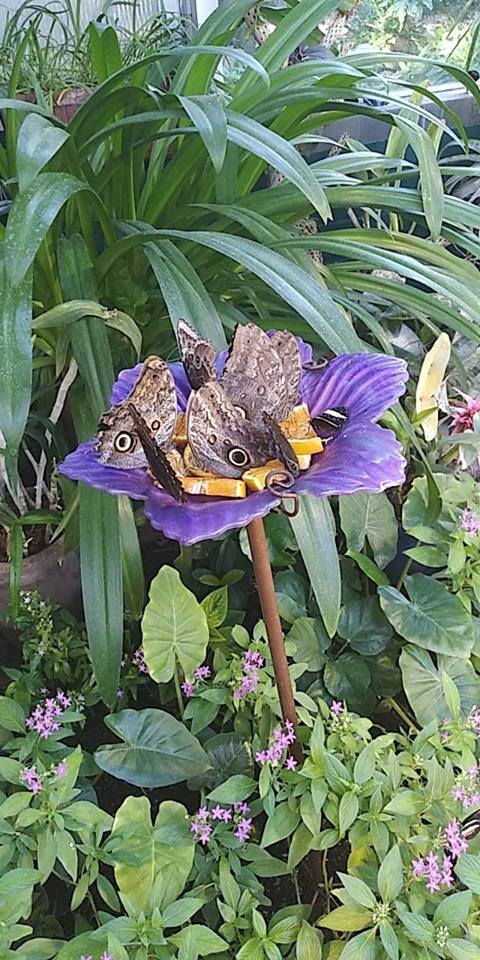
Today my friend and I strolled through the Tucson Botanical Gardens and we had it almost to ourselves.  One chicken, multiple birds and butterflies accompanied us and a few lizards skirted across our path.  Enjoy these few photos.  I went a little crazy on my facebook page, too. www.facebook.com/anitafonte


Sunday, October 7, 2018

The Blue Scarf

She wore the blue scarf around her shoulders. A light wind picked up its edges, caressing her as Reginald used to do.
Seeing him off at the metro station, she knew that being alone for a week was an opportunity to dare herself to do something differently.
She tied the scarf in a knot around her throat, hiding the scar.
When he returned, she would not be the same woman.


Sunday, September 2, 2018

Bits and Pieces of Children's Writing

Bits and Pieces from the prompts in Children’s Writer’s Notebook
A.A. Milne
Inventing characters from your childhood and write a 300 word adventure
Brownie:  stuffed collie dog; Teddy: teddy bear; Oma: sock like toy; Mortimer:  Mickey Mouse toy; Lulu:  finger puppet
Location:  Reid Park, Tucson
It was a sunny day for an adventure at the park.  For three days it rained and the five friends were stuck inside the adobe house.  But the with sun reappearing, Mortimer woke and cried, “It’s play day.  Let’s go to the park!”

“Not before I brush my fur.”  Brownie stroke his golden ears with his paw.

“Let’s go somewhere to explore,” challenged Mortimer as he tightened his red vest and grabbed is black walking stick.

“Ohh.  Not some place too scary,” cooed Oma.  “And I need to eat my breakfast first.  I am a growing girl.”

“I say we make our breakfast a picnic in the park.”  Lulu hopped to the cupboard and began to pack up milk, apples and cheese.

“I’m with you, Lulu.  How can I help?”  Brownie pranced behind Lulu, wagging his tail that brushed against the door as Mortimer opened it. 

“I don’t need any help with the food, Brownie.  But you can grab a blanket for us.”  Mortimer was ahead of everyone, going out the door and into the sunshine.  

Brownie grabbed a blanket from his bed and carried it in his mouth.  He tried to bark but it came out with just as a puff of air, muffled by the blanket.  His brown eyes gleamed with excitement.  He trotted closely behind Mortimer.

Oma took her time, looking at the birds and carrying the basket of food in her arms.  When all of them arrived at the park, Brownie led the way to a shady spot under a mulberry tree and dropped the blanket on the grass.  Oma put the food in the center of the blanket and each of them ate their fill.

 As they wiped crumbs from their faces, Mortimer stood up and held his walking stick in front of him.  “Okay.  Now it’s time for us to explore the rocks by the waterfall.”

This was a challenge for Oma was did not like getting wet.  It took her a very long time to dry when she was washed. (337 words).


Roald Dahl
Naming Characters using an unusual first name with a surname that is a condiment or sauce
Gladys Worcestershire, Edith Pickle, Grover Dill, Archibald Gherkin

Pick one of the characters and compose a character sketch in a single paragraph
Gladys Worcestershire is a woman of her early 70s.  She dyes her hair jet black with a blue streak down the middle.  She wears her hair in a tight French twist.  She is bulky and short, shaped like the bulb of a turnip.  She works as a school crossing guard, wearing comfortable cargo paints in green with long sleeved yellow and white striped cotton t-shirts.  Her shoes are high top black converse sneakers with red ties.  She wears polka dot socks in red and white or blue and white.  She frowns at the traffic as she raises her stop sign for the kids who need to cross.  As they pass by, they “high five” her and smile.  While they are waiting at the curb before crossing, she spins off a tongue twister or knock knock joke.  She loves her day job.  

At home, she has two cats, Bogart and Bacall, who fight for their spots on the kitty condo or sleep under the bed while Gladys is gone.  In the evenings, they curl on her feet and she reads aloud to them from Robert Louis Stevenson stories and poems.