Showing posts with label short story. Show all posts

Saturday, November 3, 2018

The Blue Scarf draft preview


The Blue Scarf

Nora Bergatti wore the teal blue and gold scarf around her shoulders.  An early autumn wind off Lake Michigan picked up the silk  fabric, stroking her cheek as Mama used to do.  Seeing her husband, Hugh, depart for the airport that morning, Nora knew that being alone for a week was an opportunity to explore the unpacked art files in her office.  She removed the scarf from her shoulders and rolled it into a ball, tucking it into her satchel. As she walked up the steps to the museum, she patted one of the two marble lions on his head--a gesture of habit since she and Mama visited the exhibits every month in thirty-five of Nora’s forty years.  Even with Mama gone, the habitual gesture recalled those visits. 

But Nora was unaware that when Hugh returned, she would not be the same woman.  The blue scarf in the satchel knew this.  Since 1885, it carried all its memories between its threads of blue and gold--

My story is an old one, but not as old as the scarves made before me.  Each of them as a story, too.  But this is mine.  My makers weren’t weavers.  They were textile workers who came from farms in disarray.  The centuries old feudal system in Italy, as in most of Europe, was gone.  Peasant farmers were free, but as poor as ever.  They had land, but no tools to work the land.  Their former masters now could enslave them in debts for tools, for housing, for food.  So many of them left the hills, such as my textile workers.  They came from the Abruzzo region and entered Roma, looking for jobs in the newly built factories that were close to water and land transportation.  The trains came in the late 1880s so workers could live in the cities, work, earn some money, and return back to the farms to work their land.  

These workers didn’t bend and weave the silk threads.  The threads continued to come to Europe over the Silk Road from Asia.  The workers learned how to operate the silk through the steam-powered Jacquard mechanisms.  These machines cut textile labor by half and so costs could be reduced.  There was a new middle class emerging that wanted the finer goods that only the rich used to be able to purchase.  The new machines changed everything and transportation also became less hazardous and more efficient. 

A new style of design for patterns came from France, called Art Nouveau.  In Italy, it was called Arte Nouva or Stile Foral.  The designs were made in sinuous lines, whiplash curves, flowing lines, expressing a new freedom and release from traditional textile designs.  This design style affected the visual imagination of women who felt the flowing lines in their hands.  The sense of energy for a new life for women slowly came into the daily life of those who could afford the fabrics.

Such is the story of my first owner, a woman named Maria Fontevilla who lived in Fiesole.  Fiesole was an ancient Etruscan village, but Maria was from Roma.  She had married Raphael ten years before the blue scarf entered her life.  Then, Raphael had completed his legal studies.  Now, he was the Mayor of Fiesole and he bought me from a shop in Rome while finishing a legal case in the city.  It was the eve of his tenth anniversary to Maria.  Lately, she had been more subdued than usual.  In these ten years, the third baby was a fussy one and the other two boys were at an active age.  So sleep for his wife was a rare visitor.  Raphael saw the silk scarf and thought, with its golden threads woven like a river around its edges, Maria would be reminded of Roma and happier times in their marriage.  

So I was wrapped in parchment paper, rolled into a bundle that could fit in the carriage behind Raphael’s work papers and we went up the steep hill to Fiesole. My long life as an accessory to three women and one man’s stories had begun.  Like her great-niece Nora, Maria was unaware how my presence would change her forever.

“Here you are, my lovely.  You might have thought I forgot our anniversary, but I did not.”  Raphael offered the paper bundle to the woman sitting at the table who held a baby nursing at her breast. The baby sniffled and Maria pushed it away and wiped its milky lips with a cloth.  She looked up at Raphael with a slight smile.

“Well, you are forgiven then.  For forgetting to say as much to me before you left.  So busy you were with your life in the city.”  Maria sighed and placed the baby in a cradle next to the table.  “Now you are fed, Claudia, please be content for a few moments.”

She took the rolled bundle from her husband and untied the raffia string, slowly unwinding the parchment paper.  A hint of blue like the ocean appeared.

“What is this, Raphael?”  Maria's smile widened.

“Something new I saw today.  I liked the colors as they shone in the window.”

“Oh, my."  Maria unwrapped the scarf and the glints of gold caught in the setting sun, the blue fabric rippling like liquid in her hands.

“It is so beautiful.  So fine.  Too fine for a weary mother like me.”

“No.  It is perfect for you,  For a new mayor’s wife.  You will wear it to the next town meeting to show everyone you are a lady of this village.”  Raphael picked up the scarf and looped it gently around his wife’s long neck like a bracelet.  It fell across her full breasts and his eyes lingered.

Maria touched the silk and a current of energy from it flowed into her fingers.  Then the energy flowed into her quickening heart.  Her eyes opened up to see the sun in the window and, for the first time in months, her legs felt strong again.  “I am a lady of this village.  I am more than a milk cow, cook, cleaner, and nurse to little boys’ colds and knee scrapes,”  she murmured.

Yes, I whispered into her blood as it flowed throughout her body.  I was made of silk from China, tended in a silkworm farm by a Chinese farm girl.  She blessed the silk with her pure heart and mind and now her soul is mixed with yours.  My magic has begun.

Sunday, October 7, 2018

The Blue Scarf

She wore the blue scarf around her shoulders. A light wind picked up its edges, caressing her as Reginald used to do.
Seeing him off at the metro station, she knew that being alone for a week was an opportunity to dare herself to do something differently.
She tied the scarf in a knot around her throat, hiding the scar.
When he returned, she would not be the same woman.


Tuesday, December 5, 2017

Alicia Frame story completed and now being edited

by Edgar Degas

I met my goal of 15,000 words for my first attempt at a long(er) story and exceeded it: hitting 20,040 on 12/2.  Now I begin the editing stage for "The Bare Things" and plan to have a finished version by the end of January 2018.  I learned a great deal about writing and about myself during the #nanowrimo2017 experience.  I wouldn't have done it without the challenge to Write a Novel in November and our online community of global writers.  While 50,000 is the word count for the goal for a novel, I went for a more modest one, a long short story or novella--yet still a bit leap from my poetry and flash fiction genres.  

While I develop the story in the next phase, I will keep learning and will let you all know when the story is completed and how to access it.  My intent is to share it first with the few donors who supported NaNoWriMo and then with all who are interested in reading about Alicia and the other characters in the story.  This includes Madame Celeste Bonne who was once a milliner as pictured in the painting above by Degas. She becomes a key ally to Alicia and her quest to leave Paris for a life in America. 


Tuesday, November 7, 2017

My protagonist comes to life

This painting, probably by Modigliani (according to NYT story) is the image I am using to "frame" my protagonist, Alicia Frame, on my first short story/novella/novel "The Bare Things".  I am writing almost every day, averaging 600 or more words as part of #NaNoWriMo2017, National Write a Novel in a Month.  Joining other writes around the globe, I even put up a fundraiser for this non-profit effort, and it was interesting to see which (a few) Facebook friends decided to contribute. 

My story is set in Paris, 1925, where American writers Hemingway and Fitzgerald hung out at cafes, bars, and partied in jazz clubs until dawn.  As I deal with a personal health issue, I am finding that writing this story helps me detach from my everyday life and escape.  It's good for my soul and I may even be crafting a story worth sharing!!


Tuesday, January 17, 2017

Vanessa's opening page

I rewrote my first draft which was in 3rd person/omniscient with past tense to first person and past tense.  Learning, as I go, how important POV (point of view) is to the voice of my story.

The ice storm was dripping into its third day. I wasn’t content to stay inside my apartment practicing the Vivaldi flute solo or reading Tolstoy, so I wrapped three woolen scarves around my ears and scarred neck, tucked the edges under my orange fleece jacket, and declared to Sam, my well-fed cat—
“I refuse to be held a captive any longer.”  Closed spaces brought back tremors in my hands and I had seen them tremble a few minutes earlier.
Out the door and into the cold.  But not for long.  My favorite café was just around the corner and I walked into the warm setting with a smile.
“Hi, Nate.  Busy day today for you, right?”
Pressing steamed coffee into a latte, Nate nodded, his brown eyes flashing a welcome to me.
After ordering my chai latte and warmed up from the inside, I made this a quick café visit and hailed a cab as I exited.
“Where to, miss?  Somewhere warm for you, I hope,” the cabbie asked as I slid into the back seat.
He switched on the meter and turned the heat fan up to high.
“Art Institute, please.  And thanks for that extra blast. It feels good.”
Driving down the slick roads took the usual ten minute ride a bit longer, but I was cozy in the cab and finishing my latte.  I began to anticipate my usual visit to the museum.  It was a favorite place to enjoy afternoons with Mama, and, since her passing three years ago, it had become a more important “artist’s date” to keep.
Mama had shown her own watercolors at small suburban galleries, but I hadn’t inherited the visual talent.  Instead, I’d watch her paint to classical music and felt soothed by flute sonatas even as a toddler.  So, when the time came to pursue my artistic training, I left my crayons in my desk and started elementary school Saturday lessons with Mr. Petri.  He was first flutist in the Chicago Symphony and, Mama had insisted to Papa, “We want the best for our little, Vivi.”
“The best for her at this age is to listen to her Papa and not fuss when we go to Mass,” was his reply.  But Mama had scoffed at the reminder of my rebellious shortcomings and so began my twenty year journey to first chair in the Symphony.
“Here we are, safe and sound,” repeated the cabbie.  He may have announced our arrival twice, but I was caught up in my memories.
“Oh, sorry.  Here you go.”  I paid the driver and scrambled out the cab, watching my steps on the slick steps.  The paired lions had frost on their manes and ice formed on their moustached mouths.  I gently patted one of the paws—a habit I’d learned from Mama and kept through the years. 
“Thanks for guarding the beauties inside,” I whispered as I passed the regal statues.

Inside the lobby, I sighed as I shook off the scarves, unbuttoned my coat and walked over to the coat checker.  My heart fluttered a bit as I anticipated my walk through the hallways to the painting that linked me to my past.

Monday, October 3, 2016

Introducing Vanessa

image from NYTimes T magazine, September 2016

Introducing Vanessa, chic gal on the streets of Chicago.  She plays the flute in the Chicago Symphony and has a loft apartment on Wabash.  Her favorite off-hours place to hang out is the public library--when she's not visiting vintage shops in the suburbs like Geneva and Elgin. She is going along with her boyfriend, Brad, and his Cubs fan base, but she's really more interested in "da Bears."  Yes, she once lived in NYC but she moved up to first chair in the Chicago Symphony at a random audition last spring and doubled her income, tripled her living space, and bought a used VW jetta.  Let's follow her on her adventures. She may even start traveling with the Symphony's off-season quartet to a concert hall near you.

Scene 1:  Yesterday, after a quick jog around Lake Michigan, Vanessa took a cab to her favorite cafe. (Parking is always a challenge at this little neighbhorhood spot, so sometimes it's best to leave the Jetta in the garage.)  She met up for dessert with her best friend, Linda, who plays clarinet in the Symphony.  Vanessa was meeting Linda's new beau, Charlie, for the first time.  And even the lush desserts weren't as sweet as Charlie (first impressions are important).

"Where's the match up for me?"  Vanessa thought as she finished off the last of the tiny desserts.


So her story continues....

Tell me what you what Vanessa to do, say, experience--let's build this story line together and have some fun!
(An experiment with social media and comedic creatives)

Sunday, July 31, 2016

A short short story with three more words of happiness.

Timothy's Time

Timothy enjoyed playing with his Tinker Toys,  Building a turning ferris wheel from wooden spools and brightly colored sticks entertained him for hours.  While other children were fixated on their phone screens following Pokemon Go critters here and there, Timothy built things.  Pleasure for Timothy was imaging his next build project, studying architectural plans in books, drawing images of it on scrap paper he picked up from the library, and returning home with ideas sprouting from his the top of his brown, fuzzy head.

His walk home with his mom, past the park and into his neighborhood was a celebration for all that was possible to an five-year-old, freed at last from chemo tubes.

Friday, July 1, 2016

A boy's story

This was written as a submission to a Hemingway short story contest.  Since I haven't heard from the contest sponsors, I am assuming this story will not be given an award, so I am free to publish it with the addition of a photo of "Raphael", my dad in his Army uniform.


Master or Fool: a tribute to Ralph P. Fonte by anita c. fonte

So while his wife was at mass with the children, he finished corking the last bottles of wine in the basement.  Satisfied with the job, he sat on the cool cement step and slowly ate an apple with a slice of cheese.  When his wife returned, he would ask Raphael to join him outside in the garden.  Ripe tomatoes hung from the vines and needed to be picked.  While picking, he would start the conversation that he practiced in his mind.

“See this one; she is almost too full. We must make sure we clip her stem and take her inside to Ma.”
“I know. I will do that.”
“Grazie, you understand.  And there is more I need.”
“Of course, just tell me what you need me to do.”
“I can’t bend and carry water to the trees and plants like I used to.”
“Sure, I can do that.”
“No, not just here. But at Flores’ place.”
“You mean where you work?”
“Si.”
“But you do that in the morning when I am at school.”
“Si.”
“So what are you asking?  You know I only have a few more weeks before I finish.”
“Si.  But now is when I need you.  It doesn’t matter if you finish.  You can work.”

At this point, his imagination failed him.  What would if he do if his son refused, insisting to stay in school?  Bah, he was the papa.  If his children didn’t obey him on all things, then he was also a failure at home.  No, he would insist.  If not with words then with the slap of his hand.  Si, if it came to that.  Just like his papa in the old country.  One is the master or one is a fool.
He got up.  He heard his children singing in the yard.  He went up the steps and opened the green cellar door to the blue sky.

“Raphael. Come here.  I need you in the garden.”
“Si, papa.”

Friday, July 19, 2013

Beyond Counting Clouds

prompt words:  name, number, look, hear, up, evening, welcome


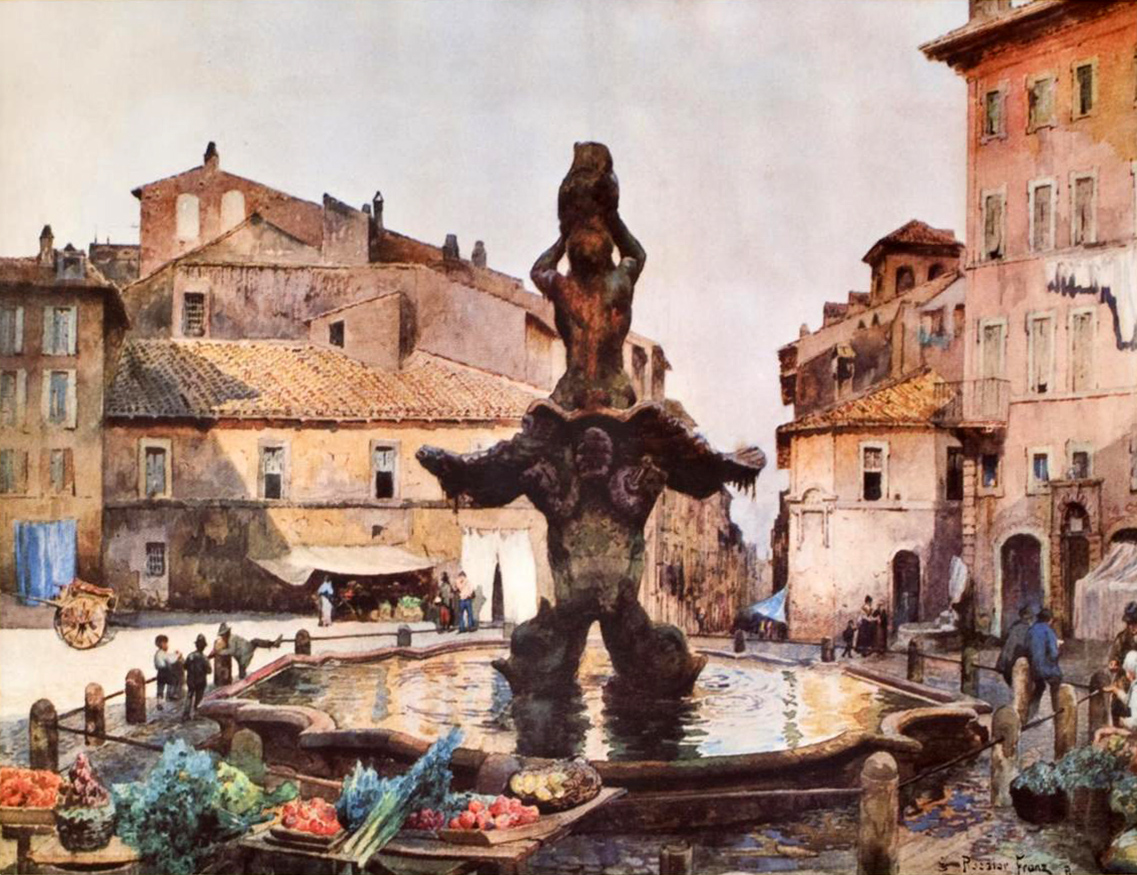
File:PiazzaBarberiniByRoeslerFranz.jpg


It was turning out to be more significant evening than Alicia had expected.  Paolo had accepted her cake and berries with a welcome kiss on both cheeks, and his daughter, Sophia, had hugged her closely around the knees.  The look the child gave her at dinner, as Alicia shared stories about her Italian fountains expedition, was one of awe.  Sophia asked if she could accompany Alicia on the next day’s fountain journey and ran to her room to get a piece of paper so she could give Alicia her phone number.  This request was a surprise for Alicia to hear. While she was gone Paolo explained, with some temerity, that Sophia still missed her mother, gone now for two years, and, since Sophia was an only child, she sometimes clung closely to her Papa and worried about his own sense of loss.  


Alicia was cautious about making a commitment too soon to the child.  Looking for fountains in Italy had become her private pleasure and sharing the experience and the expectation might be too much, too soon. Giving up that privacy was giving up a part of herself. But, when Sophia returned with her piece of paper and called Alicia by name, the vowels spilling like water with the Italian emphasis on the final “cia”, she couldn’t help but smile and acquiesce to Sophia’s request.  They would meet outside the Museo Nazionale Romano, near the Termini station, and decide which direction in the city they would go, looking for another fountain of Rome. 


Thursday, July 18, 2013

Flash Fiction: Counting Clouds


Counting Clouds

In Rome, it seems to Alicia that every corner has a fountain.  Whether she is walking near the Tiber River, or going to one of the bus ticket and book stands to buy a British newspaper, the sound of water slowly cascading over the necks of horses, pineapples, turtles or mermaids beckons her to pause for a coffee and count the clouds in the sky.  She came to Italy with the purpose of finishing her book of poetry, but that goal is now gone for the near future.  Instead, she has made it her purpose to try to visit, photograph and write a phrase or two about every Roman fountain.   

Yesterday, she stopped on a path along the shore of the river to watch three boats glide beneath the bridge of Castel Sant’Angelo.  While there, a familiar man with his daughter passed her by and they chatted.  He invited her to dinner tonight and she is wondering what she should bring to the meal.  She knows he is a widower and that he likes fruit, which she often saw him carrying in his market basket and every Italian likes sweets.  So, she will buy a cake and bring berries along with some of photographs of the fountains. They will get to know each other a little better and she will be open to possibilities.